
Category: thought literacy
-
Documented Impact of Thought Literacy
Thought literacy is the awareness and management of thoughts. It treats thinking as a meta-skill domain that shapes every cognitive skill, including emotional regulation, decision-making, learning, and identity formation. This document outlines real-world examples of how thought literacy has impacted individuals, drawn from reader feedback, coaching experiences, and applied practice. The purpose of this document…
-
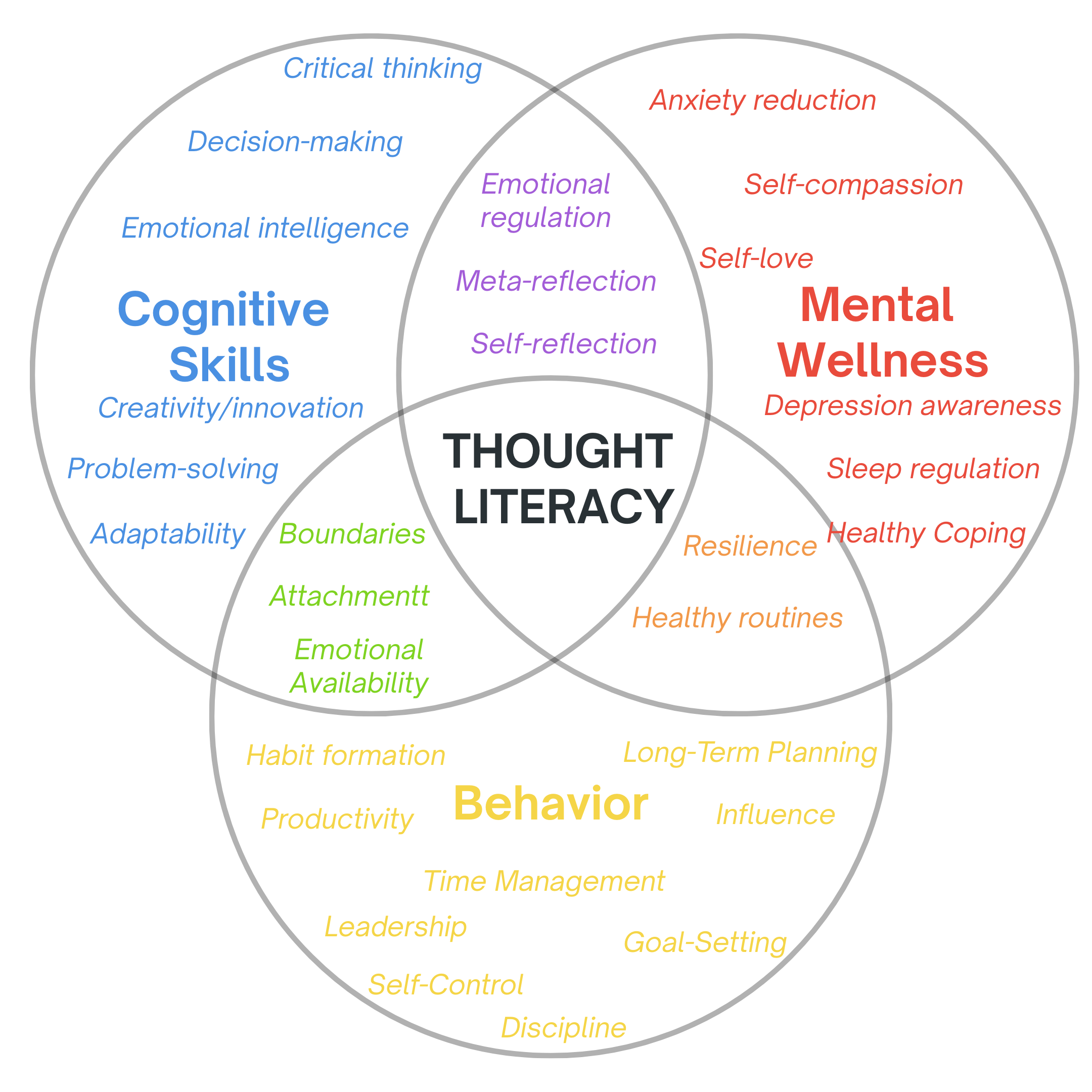
How Being Thought Literate Improves Your Life
Learn how managing your thoughts strengthens skills, improves mental health, and supports long-term behavior change.
-
Building the Skillset for Thoughts
This living timeline documents the structured development of thought literacy, the skill set for thoughts.
-
Thought Literacy General Assessment
Check your current thought literacy skills and how effectively you notice, manage, and apply your thoughts.
-
Changing Thought Patterns Is a Skill You Can Learn
Unconscious thought patterns shape mental health, confidence, and relationships. I developed a framework for bringing any pattern into awareness and changing it.
-
You’re Closer to Metacognition Than You Think
Metacognition is a strategy-based approach to learning and problem solving. It’s practical, actionable, and something anyone can develop. Most people know it as “thinking about thinking,” but that’s just a literal breakdown of the word and doesn’t tell you what metacognition actually is or how to practice it. If you want to learn metacognition, chances…
-
Watching My Work Get Erased in Real Time. Living the Matilda Effect
A reflection on my personal experience with the Matilda Effect and the ongoing erasure and misattribution of women’s intellectual contributions.
-
Thought Modeling for Cognitive Skill Acquisition Through Internal Dialogue Examples
Independent cognitive skill development is largely limited to formal programs, leaving few accessible pathways for self-directed learning. Therapeutic interventions address maladaptive thought patterns reactively, but individuals seeking proactive cognitive growth lack concrete models showing how adaptive thinking operates in everyday contexts. Thought Modeling addresses this gap by systematizing cognitive skill acquisition through structured internal dialogue…
-
Your Nervous System Isn’t Broken, It’s Following Directions
What’s marketed as nervous system healing is actually a collection of coping mechanisms that ignore the root cause of anxiety and panic.
-
It’s Okay to Change Your Mind
Why do we treat saying ‘I don’t know’ like a personal failure? Learn how cultural pressure undermines critical thinking and what to do about it.
